Friday, August 24, 2018

Weekly Torah Portion - Ki Tetze (Deuteronomy 21:10 - 25:19)

In this week's Torah Portion from the Book of Deuteronomy, Moses continues his goodbye speech to the children of Israel, just before their entrance to the Land and his own death. Many commandments are detailed here, but today I'll focus just on one or two of the commandments in it. 

Deuteronomy 24: 14-15:
"Thou shalt not oppress a hired servant that is poor and needy, whether he be of thy brethren, or of thy strangers that are in thy land within thy gates. In the same day thou shalt give him his hire, neither shall the sun go down upon it; for he is poor, and setteth his heart upon it: lest he cry against thee unto the LORD and it be sin in thee."
G-d asks us to be fair and considerate with the people we employ. "A servant" in Biblical times can be translated as "an employee" in modern concepts. The commandment is for an employer to not withhold due wages from his/her employees, but rather to pay their salary on time.
In this context, I would like to share the following story about a Jewish man from America, Aharon Feuerstein, a businessman and philanthropist, who was the CEO of a textile factory ("The Malden Mills") in Massachusetts. This factory employed 3,000 employees, giving these people their salaries, livelihood and dignity as working man. It supported the economy of two whole towns near by. One day in 1995 the factory was burnt down. Everything was gone. Owner and employees were distraught. Even though the place was insured, it would take many long months before the factory could be rebuilt, and for the employees it meant 6 to 12 months of no work, no salary, and facing the uncertainty of what the future holds - should they look for another job or wait for the factory to be rebuilt?
Feuerstein chose a very unusual, noble course of action. While he was using the insurance money to rebuild the factory, he kept all the 3000 employees on pay roll. Even though he couldn't give them work during the long months of rebuilding, he kept paying their salaries and giving them their benefits. He did this in the 1990's when globalization was accelerating and many companies were firing their local employees and moving to China and other places in the Asia.
This cost him something like 25 million dollars, and - he lost his own job for doing this. But he won his life at the same time. A person who merited to do something so noble and so great is a man who lived a life worth living. He didn't waste the chance he was given to make a difference in the world.
When asked about it later, faced with the consequences of his deed, he said he would have done the same thing again. Why? Because it was the right thing to do. He attributed his decision to his life-long study of the Torah and the Talmud, quoting the teachings of ancient rabbis like Rabbi Hillel: "In a situation where there are no righteous people, be righteous". He said in an interview: "Maybe on paper our company is worthless to Wall Street, but I can tell you it's worth MORE". Hearing about such people makes one feel good about mankind. We still have hope.
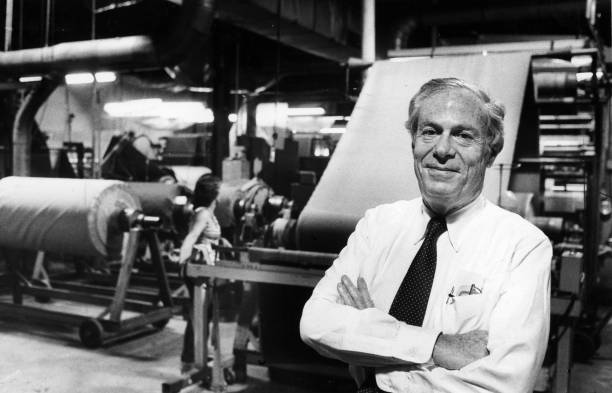
Image result for aaron feuerstein factory
Aharon Feuerstein
Another interesting story that I would like to share with you just before Shabbat is related to the verses in Deut. 22: 13-19: "If any man take a wife, and go in unto her, and then hate her, and lay wanton charges against her, and bring up an evil name upon her... Then they shall punish him...". 
Speaking evil words against another person is a horrible sin in Torah Law. Our mouths can easily turn into lethal weapons, and kill a person with our words, ruin a person's life, etc. We are commanded to keep our mouths holy, to use it as a vessel of sanctity and purity, a vessel to bless G-d, pray to Him and speak of His glory, but not to ruin another person's life with it. Unfortunately, the sin of evil tongue is very common in all societies around the globe.
In 1873, a book was published by Rabbi Israel Meir HaKohen about the rules and safeguards we should all observe in order to keep our mouths clean and avoid ruining other people. The title of the book is: "HaChefetz Chaim" (lit.: A person who desires life), and it's taken from the verse in Psalms 34: "Who is the man that desireth life, and loveth days, that he may see good therein? Keep thy tongue from evil, and thy lips from speaking guile.". This book is very famous in Israel and in the Jewish diaspora, and people learn small portions of it daily, and talk about it and discuss it. Rabbi Kagan is known as "HaChafetz Chaim" because of this book.

The story I want to share with you in this regard is about an Israeli man, someone who prays at a synagogue in which I pray. That man used to work in one of the highest positions in the Bank of Israel, and after retiring he now works as an international consultant. Recently, that person returned from a trip to Mongolia, in the Far East, and told the following story:
When the Deputy Governor of the Central Bank of Mongolia met him and saw the Yarmulke (kippah, a small cap worn by religious Jewish men) on his head, he asked him if he knows Rabbi Israel Meir Kagan, and added, "perhaps you know him by his name taken from the title of his book, HaChafetz Chaim".
The Israeli man was shocked. Here he was in Mongolia, as far away from Israel and Judaism as can be. How would the Deputy Governor of the Bank of Mongolia know anything about Rabbi Kagan or his book? He was curious. So he asked the Mongolian man: "How do you know about Rabbi Kagan?".
The Deputy Governor told him that he completed his PhD in the United States, and that his adviser was a Jewish Professor. In one of his conversations with his adviser, the Deputy Governor told the Jewish professor that the staff meetings in the Central Bank of Mongolia are not efficient at all, because all of the participants yell at each other for the entire duration of the meeting.
The Professor listened, nodded, and then gave his student an English translation of Rabbi Kagan's book titled "Guarding of the Tongue" (published 1876), and the Deputy Governor took it. He read it thoroughly with increasing interest. He was so deeply impressed with the contents of the book, that when he finished his PhD he returned to Mongolia and brought with him more copies of the book. He told the staff at the bank that no one would be allowed to participate in the staff meetings without first reading the book. So everyone read it. Ever since then, the staff meetings at the Central Bank of Mongolia run very smoothly and peacefully, and are very efficient.

This is a true story from my neighborhood in Jerusalem.
It is amazing how the Torah pervades every corner of the world and makes people better, makes lives better, makes bank meetings better :-)
Baruch Hashem.

And with that, I'll say to you Shabbat Shalom, and I hope to see you again next week or the one after that.

Yours with love,
(You know who I am)

Thursday, July 26, 2018

Weekly Torah Portion - Va'Etchanan (Deut. 3:23 - 7:11)

Something very sweet and positive happened today. An Arab man from the city of Hebron gave a "LIKE" to a post on my Facebook page ("Jewish Inspiration") with a quote from the Mishnah (an ancient Jewish text). How amazing it is! It gives me strength and motivation to keep running this page. At the moment there are over 500 people who like the page. I hope to have more soon.

To write this blog today I came to a hotel lobby in East Jerusalem. I walked here all the way from the Hebrew University on Mt. Scopus, going through the Arab neighborhoods and the streets (Mt. Olive road and Nablus road), and feeling so free and happy that this is my city and I can walk here freely. The streets are so beautiful! Only recently I had the courage to come here, to walk here, and discover these areas. Up until not too long ago this part of the city was beyond the horizon to me, so to speak, a place you know exists, but to which you never go.The people on the streets here are mostly indifferent. I don't feel much hostility, and it is good. I'll keep coming here.

This week's Torah Portion is that of Va'Etchanan ("I implored"), Deuteronomy 3:23 - 7:11. In it, Moses begs to G-d to let him enter the Promised Land, but G-d refuses, and asks Moses not to pray to Him about this matter any more. He will only merit to see the land from afar, but not to get into it.
A few points to mention here:
First, seeing how the great Moshe wanted to enter the Land and couldn't, I feel so humbled. He couldn't, but I can. He would have given anything in the world just to merit to sit here, where I sit now, and see the hills of this Land with his own eyes, just like I do. It makes me feel grateful that I have the merit to live here, to walk here, to breathe the air here. It is something that generations of Jews could only dream about, and here I am, living their dream, almost taking it for granted sometimes. A point to remember on dark days.
Second, sometimes we want something so badly, we pray and pray and ask G-d to grant us what we want, but His answer is NO. We cry, we try to fight it, but nothing helps. No is no. It often happens with things in our lives that are our Promised Land, the things we want most in life, but can't get, often things we were supposed to have but lost due to our mistakes. If it happened to Moshe (Moses), it is OK that it should happen to any of us.
Third, Moshe was not buried by men, and no one knows his burial site, so we can't go there. One of the reasons for that is to make sure that Moshe will not turn into a "god". It comes to ensure that people will not start to worship him and pray to him and treat him like a god. For he is not. He was our savior, he still is, considering the fact that it is the Torah that he brought down to us that we keep learning for thousands of years now, on a daily basis. And this Torah is the basis for other faiths who sprang up from it. All thanks to him. So his influence is not just on us, but on almost every person in the world today. But still, G-d is one, and Moshe is just his emissary, not a second "god", G-d forbid.

In this portion is one of the verses that I like most. It was one of the (many) verses in the Bible that opened my eyes to the truth of the words of the Torah and the Prophets. Before I quote it, I will tell the background. Many years ago I was a student in Japan. I was secular back then, but like most Israelis I believed in G-d. I just didn't think the Bible was G-d's word. But G-d has different ways and many different emissaries to help open a person's eyes. When I was in Japan, and when I visited Korea, whenever I met new people and we introduced ourselves, they would say: "Oh, you're from Israel? Then you must be very smart!". The first time I heard it, it amused me. "If only they knew how many people I know back home who are not so smart...", I thought to myself wryly. The next times I heard it, it started annoying, even scaring me. Without even knowing me, just by hearing that I am Jewish, they made a definite conclusion that I must be very smart. It smelled of prejudice, and it could be dangerous. What else would they assume about me without knowing me? It started bothering me. I carried this tormenting question in my mind for a few days, and then on a certain Shabbat I went to the Synagogue in the city where I lived, to have a Shabbat meal with Israeli food. I took out a Bible on a whim from the book shelf, and opened it randomly, not knowing why I did this. Just like that. The book opened on this week's Portion, on the following verse, which helped change my life: "... For this is your wisdom and your understanding in the sight of the nations, that, when they hear all these statutes, shall say: 'Surely, this great nation is a wise and understanding people'." (Deut. 4:6). I paused. I felt shivers down my spine and chills all over my body. Here I was, a student in a far away country in the other end of the earth, and everywhere I went, people concluded that I must be very intelligent without even knowing me, just by hearing that I was from Israel. And here this ancient text, black on white, written more than 3000 years ago, and the reality that this verse describes is my own reality. It was one of the 'cracks' in my shield that helped me realize that the Torah is true. The verse just prior to this one says that we should keep G-d's commandments, and this is a condition for our wisdom. And indeed, it is mainly through the mechanism of us clinging to our faith and observing the Mitzvot (commandments) that we were kept as a separate nation, with our tradition of loving and learning the Torah. This, and the blessing of G-d to Abraham ("you shall be a blessing to all nations"), are the source of this perceived wisdom.
When I visited Korea (no need to say South Korea, right? If I had visited North Korea I wouldn't be sitting here writing this blog today), I stayed at a special guest house (Kim's Family Guesthouse - recommended if you're ever in Seoul!). The woman who runs the place, Sunny, told me that in every household that respects itself in Korea there is a copy of the Talmud. I told her: "What? A copy of the Talmud?!" Being "secular" then, I don't think I ever even saw a copy of the Talmud, and here this Korean lady tells me that they have it in every household in her country. "Why?", I asked her in disbelief. Then she said that education is very important to Koreans, and since the way the Jews educate their children produces geniuses (her words), then Koreans want to replicate this method of education to make their children geniuses too. Needless to say, I was speechless. I didn't know what to say. I was shocked. Years later I realized that even though they think that what they have in their homes is the "Talmud", what they really have is a short introductory book (I would title it "Talmud 101"), written by a Jewish rabbi about the Talmud. That Rabbi had it translated to Korean, and they cling to it with reverence as if it is the real thing (the real Talmud is made of a few big volumes, it is a very big book). I find it very sweet and admirable. I'm sure that after reading it they know much more than any secular person here ever does, but not even a fraction of what a religious man here does. Still, it's something!
Throughout all this Portion, Moshe repeats the importance of us keeping the Mitzvot (commandments) for ever, not just the generation of the desert, but all generations into the future. There is such a big emphasis on it. It reminds me of another story: 
Last year I visited Norway. I still have friends there from my previous visit there in the fall of 2006. A friend of mine organized a few salon-talks for me. We gathered, every time in another home, with a different group of people, for a talk about Judaism and Israel. In each of these homes there was a lot of delicious-looking food served. Everyone was eating. And yet, even though I was hungry (I lost some weight there) I kept the Kosher laws and restricted myself only to what I could eat. It wasn't much. It wasn't easy, physically or socially, but I was determined to do it, and I did. 

One of the participants in one of the talks later came to Israel for the first time in her life. I met her here, in Jerusalem and we had a long, pleasant talk. She told me that when she saw how I was eating (or not eating, "like Daniel"), she realized that it's through such commandments that G-d kept the Jews as a separate nation, and that His covenant with us is still alive, that He has a plan for us, and that we don't need to go in the pathway of all the other nations. I was shocked and excited to hear it from her. Of course, I knew it myself all along, but it was quite emotional for me to hear someone who comes from a different faith say such things to me. She isn't the only one. Other people have told me so too after seeing me eating "like Daniel". But it was so nice to hear about it from her, and the way she said it! 
When I was in Norway someone asked me why I don't eat the food, is it because I think it's not clean or tasty? The answer was absolutely not! The food looked clean and the fresh, and most delicious. So why didn't I eat? Not because I didn't want to, believe me - I wanted to eat every bite of it! The only reason I didn't eat, is because G-d commanded me not to eat certain things! 

If it's not clear, think about Adam and Eve in Eden. Here there was a beautiful fruit (let's say an "apple"). A beautiful, red, fresh apple. There was nothing wrong with this apple. The only reason why Adam and Eve should have avoided eating it is not because it was bad, but because G-d told them not to eat it. That's it! The apple itself was probably great, but G-d said no, so no it is, and that's it! If only they had kept this one Mitzvah... 
When we keep Kosher, we fix on a daily basis a part of that original sin. When we keep the commandments, we show G-d that we cling to His word, and even though we're hungry in a beautiful foreign land, we will not eat that which He told us not to eat. Only that which we are allowed to it, we will. And the result of this is that people around us start opening their eyes and realizing that our covenant with G-d is a living one and that G-d has a plan for us. 

By the way, the nations of the world also have commandments they are supposed to keep, and the righteous gentiles keep them: these are 7 basic commandments, but in reality there are more than 50 commandments that the righteous gentiles keep. We will discuss them some other time. 

Thank you, and Shabbat Shalom!
Rev.


Thursday, July 12, 2018

Torah Portion: Journeys through the stations in our lives...

I'm sitting now at the lobby of the Dan Hotel in the French Hill (what used to be the Hyatt Hotel years ago). On days that I work alone from home, I need to be out and feel that there are people around me, so I find these places. The whole city of Jerusalem is spread under me, as I sit here and write this blog today.


This week I got a call for help. Someone whom I vaguely know is hospitalized. He is a new immigrant from the US, hardly speaks any Hebrew, and doesn't have any relatives here. His acquaintance sent out a call for anyone who can, to go and visit him. He is an elderly man, I assume around 70 or more years of age, and he's been battling a disease for many years now. I went to the French Hospital where he is hospitalized, suggested to him that we should walk a bit together, just to get him out of bed and get some exercise, and then, as we were slowly walking through the hospital's corridors, he asked me if I wanted to learn Torah with him. I was surprised. It was a wonderful suggestion. In such a secular place without Torah, to learn Torah together - magnifique! In his room there was another religious man, and their room is the only room in the whole hospital with a Mezuzah (they glued it to the doorpost with sellotape). I read aloud the Torah text with my Hebrew accent, and he stopped me from time to time to comment about the different words and verses I was reading. The thoughts that I'm going to share with you today about the Torah Portion are mostly ideas that I heard from him. 

This week's Torah Portion, which will be read in synagogues around the world is that of Matot-Mas'ei (Numbers 30:2-36:13). I will focus  here mostly on Numbers 33: "These are the journeys of the Children of Israel, by which they went forth out of the land of Egypt by their hosts, under the hand of Moses and Aaron". The Torah starts here a very long list of all the places to which the Children of Israel went, and from where they then embarked on other journeys. In some of these places they stayed a day, and in others they stayed for many, many years. When you read this chapter superficially, it can be very boring - "And they journeyed from place X, and pitched by place Y; and they journeyed from place Y, and pitched by place Z", etc, for 42 journeys! Why would the Torah, in which every letter is important, and no word is there by coincidence, dedicate so much text just to repeat the journeys of Israel in the desert? After all, we've already heard about these journeys before! 

One of the messages that can be derived from this is that life is a journey. If you look at the map of these 42 journeys, you see that they were not a straight line, and were definitely not the shortest or most efficient way to get to the Promised Land. In a person's life there are many stops, and at each stop we experience things, some are good and some are bad, some are sweet and some are bitter. Sometimes the bitter experiences are actually good, because they serve us in meaningful ways, where as the sweet ones, if not understood as something from G-d, may end up harming us. The Hassidish rabbis/masters, such as the Baal Shem-Tov, said that there are 42 spiritual journeys in a person's life, that each of us makes in life: "The 42 journeys of the Children of Israel, described in this Portion, exist in fact in the life of every person, from his birth until his entrance to the upper Land of the Living. This is how the Torah tries to show to every person the desired, proper path - that is, each person must always be journeying, must always be in a constant motion of rising up and moving forward". And just as the Torah does, it is good to sometimes stop and take a look at the journeys we've done, to be reminded of things we've gone through, and to see how we grew thanks to them. 

We learn from this chapter in the Torah that it is not only the destination, the 'promised land', that is important. Many times it is the journey, the road to get to our final destination, which is important too. In every station in life, bitter or sweet, we get something, we learn something, and if we are spiritually minded, we can get the best of even the worst situations in life. I'm thinking of that man in the hospital. He's been battling this terrible disease for a long time, but his spirit is not broken. He uses his time to learn Torah, and when you visit him, you see that he is not bitter. He loves G-d and accepts peacefully that which G-d gives him, even if it's life of solitude, with no family, in a country in which few people know him, and especially his battle with the disease. He doesn't complain. He just accepts it graciously. 

Also, at any stage we are in life, even if it's very bitter, we can look around and think what we can do to make this world a better place, what we can do for other people. Even someone who is lacking some of the most essential things in life, like family or health, G-d forbid, must remember that this life is a journey, not the final destination, it's just a corridor leading us to the Next World, and what we'll do here in this world will determine our life in the next world. We will not be able to take with us money, or material possessions to the next world, of course. We will be able to take with us just the good deeds we did here, just our efforts to make this world a better place for us and for people all around us, and indeed all over the world. We will be judged on that, and if we are wealthy in good deeds, we will be OK up there, but if not, then maybe it will not be that easy for us up there... This is how I see things, and this is how our rabbis see things. 

In every moment of my life I live with the awareness that G-d is with me, supporting me, guiding me, teaching me, but also testing me. This world is like a school - we learn, and we are tested, then learn something new, and then tested again. And the tests are all moral, social and spiritual in nature. Sometimes we fail and fall, but the important thing is to get up, repent, and make sure not to repeat our mistakes again. Just move on, and make the best of every second of every day we are granted in this world. Best not in the sense of having fun, but in the sense of giving to others, volunteering, doing good in this world. This is a true source of real happiness. This, and trust in G-d and the awareness that He is always with us, around us, all of us, each and every one of us. This is the recipe for good, true happiness.

In the hospital room, as I was reading the names of the places that Israel journeyed, the hospitalized man stopped me from time to time, and here are some of his insights:

In verse 8-9 there is a mention of a place called Marah. For those who don't speak Hebrew, it is just another name, but for those of us who speak Hebrew (or learn the Torah in Hebrew, like him, these names have meaning). Marah in Hebrew means bitterness, and he said that the place was called so not because it was bitter, but because THEY (the People of Israel) were bitter. We can learn from this an important lesson: No matter where we are in life and what the external circumstances are, it is our frame of mind, our mindset, that determines the outcome of this "station" in our lives. If we are in a very beautiful place, but our mind is bitter and full of anxiety and pain, we will experience this beautiful place as bitter and painful. We all know people who have everything in life, but are depressed. On the other hand, if we are in bitter, painful situations in life, lacking important things, like family, etc., but we look at it in an optimistic way, seeing G-d everywhere, then this place will be sweeter and more positive for us. We all know people who have nothing in life, but are happy. 
This is just a small example of the meaning we can derive from every word in the Torah - our Sages (our great rabbis, commentators of the Torah) found meaning behind the names of the other places. 

The chapter ends with this statement from G-d: "unto you have I given the land to possess it". Now tell me, can anyone argue with Him? No one can. We've finally reached the Promised Land, after thousands of years in the bitter desert of exile. And we possess it. And our Prophets promised us that this time we will not be driven out of it. And we believe them, so we keep building and developing this land, which has been waiting for us for such a long time. So we're here, at the end of so many bitter journeys - but our journeys, bitter as they were, were not in vain. They were part of G-d's greater plan, which we do not fully understand. The important thing is that we're finally at our sweet, beautiful destination - not completely (the Temple needs to be built too) but almost there in full! Rabbi Harlap encourages us not to stay put, but rather to keep moving upward and forward in our spiritual growth. Especially now that we are in the Land of Israel, we have the moral obligation to keep growing, keep moving forward. The amount of Torah classes everywhere is dazzling, there is so much thirst here by people to know G-d, and even people who grew up in secular families, like me, find their way back to the Torah, to G-d, and to Torah driven life of keeping the commandments and doing acts of loving kindness. 

Thank you for joining me on this journey as I write here from time to time. 
Shabbat Shalom and Chodesh Tov (a blessed new month - tonight starts the Hebrew Month of Av)!

From Jerusalem with Love,
R. 


Friday, July 6, 2018

Kites of Peace

Very hot days in Israel right now. And in this heat, "gifts" of fire are sent our way by our neighbors in Gaza. Fire kites, fire balloons, which, primitive as they are, cause a lot of damage, physical and mental. Agricultural fields on the Jewish side of the border catch fire and burn, causing immense financial damage to the farmers. Small children, who are used to thinking of kites and balloons in an innocent way, are forced to rearrange their concepts to fit this insane reality. Of course, here in Jerusalem nothing of this is felt. The kites don't reach this part of the Land. So today, together with a few more people, I went south, to the Gaza border, not far from where I was born and raised. Thousands of people were there. The traffic jam leading to the area was very long.
We all went there for one purpose - to fly kites of peace and balloons of hope, and to support the local residents and the parents of the dead Israeli soldier, Hadar Goldin, whose body is still in the hands of Hamas, and Hamas would not give it back. Hadar's family do not ask for a 'prisoner release deal' with Hamas. They do not want our government to release terrorists from prison, like it did in the Gilad Schalit deal, because such deals bring about more kidnapping, more violence and more death. They ask instead that Israel put more pressure on the Hamas leaders in order for them to give back Hadar's body.

Many people were there today, giving talks about the current situation and about our need to keep our hope and strength. Among them were Hadar Goldin's family, local residents of the Jewish areas around Gaza, former judges and current politicians. It was quite an happening.
Very happily, I spotted in the crowd also two Arab men, Muslims, clad in their traditional Kafiyah and Galabiyah, who came to support us, to support Hadar's family and to support the local residents in the Jewish settlements around Gaza. It was moving to see them!

It was beautiful to see all these kites, colored blue-and-white (colors of our flag, colors of our prayer shawl, colors of spirituality and peace), flying up in the sky, and the kids and parents enjoying this activity. When we were there, no kites of fire were flown to us from Gaza. It reminds me of a famous phrase by the Lubavitcher Rabbi: "A little bit of light can drive away a lot of darkness". I want to believe that our little peaceful gesture, our peaceful kite flying today, caused a spiritual effect that prevented the black kites of fire from landing in our territory. But anyway, it didn't seem like the people who were there were afraid. They weren't. I wasn't either.
This week we will read in synagogues in Israel and around the world this verse from Jeremiah: "And they shall fight against you, but they shall not prevail against you, for I am with you, says the Lord, to deliver you". These words are said to Jeremiah, but I think many people in Israel live with this consciousness, that G-d is with us, and that even if other people fight us (from Gaza, or in the UN), they will not prevail, for G-d is with us. Later on it says there (Jeremiah 2): "Israel is the Lord's hallowed portion, His first-fruits of the increase. All that devour him shall be held guilty, evil shall come upon them, says the Lord". I'm thinking of the Hamas leaders, and feel this verse speaks about them these days. They do not fight us. They fight G-d, and their behavior shows that their destructive motivation is not pure. They are willing to burn their own area (one of their kites actually burned a power-supply station that gives electricity to Gaza), they are willing to suffer, they are willing to die, as long as we suffer and die. No gestures of peace are accepted. The hatred is so big. But I believe that the day will come in which they too will wake up and realize the truth that is there in G-d's words.

Here are a few pictures that I took today near Gaza (you can faintly see the Gaza Strip in the background, but the camera on my phone is not that good, so it doesn't show well).


Shabbat Shalom!
Revital


Friday, June 1, 2018

First time - Hebron

Two weeks ago was the Holiday of Shavuot, 7 weeks after the end of Pesach (Passover). It was a long weekend starting with Shabbat, and then right after that - Shavuot. I celebrated it in a very special place, which I had wanted to visit for a long time - the holy city of Hevron (Hebron). It was my first time in the city, and I didn't know what to expect.
I took the bus from Jerusalem to Hevron. It was a shielded bus, but you could never tell - it looked just like any other bus. I sat in the front seat, looking out the window as the bus traveled through the hilly terrain of Judea, reaching south towards Hevron. The road was dotted with vineyards and olive plantations, two of the Seven Species of Eretz Israel (the Land of Israel). Right before it reached Hevron, it went to a Jewish neighborhood adjacent to Hevron, called Kiryat Arba. It is a beautiful Jewish town with lots of new buildings, covered with shiny Jerusalem-stone bricks. Then, the bus continued traveling. And I found myself in Arab neighborhoods - I had no idea that the route the bus takes goes through those neighborhoods. I once had a dream that I was in Gaza. Even now I remember the streets, the buildings, the shops, the atmosphere that I saw in that dream. In Hevron, this dream came to life. The driver saw my reaction and laughed. My stop - the Avraham Avinu neighborhood (named after Abraham our father), was the one before last on that route. I was alone on the bus at that point. He told me that this is where I get off. I was reluctant, and... surprised to find myself in such a place. But it was no mistake. He reassured me that I have nothing to worry about.

I got off, walked in this Arab looking area, until I found the place where I was supposed to spend the Holiday with a few more people. Relieved, I soon found myself within a Jewish area, albeit tiny and small, with beautiful buildings covered with Jerusalem-stone bricks. At night, I went to pray at Me'arat HaMachpela (the Cave of the Patriarchs). This was the first time in my life to see that huge, powerful building. It was Friday night, and the first night of the Ramadan, so the entrance to Jews was forbidden. We couldn't get in. We had to pray outside at what is called "The Seventh Step", while the Muslims were allowed entrance and prayed inside. It was moving to hear the Jewish crowds singing Shabbat songs and praying with all of their heart and might, when in the background the Mu'azeen was calling on a loud speaker the traditional Muslim call. I found it moving to see how these young, vibrant voices of the Jewish people there were trying to overcome the deafening sound of the Mu'azeen's calls through the loud speaker. Soon I was no longer distracted by it. In this place, the Cave of the Patriarch, tradition holds that Abraham and Sarah are buried (Abraham bought it to bury Sarah, Genesis 23:8-19), as well as Isaac and Rivkah and Jacob and Leah. Therefore, the place is holy also to the Muslims, who are the descendants of Abraham (through Hagar). On the burial cave, King Herod built a magnificent edifice. This building is the only intact building from that time (2000 years ago!). I was sorry I couldn't go in it, but on the next day, our soldiers allowed Jews to go in, only at different hours than the Arabs.
I was moved to have my feet step on these ancient, old stones. The edifice is just gorgeous. It has high vaulted ceilings, and floors made of huge stones. The walls are covered with stones framed in the Roman style. On some of the stones there are engravings in Greek and Hebrew of names that sound Jewish, or Helenized Jewish (like Abrahamos, Nahumos, etc.). People 2,000 years ago engraved their names on the wall probably in prayer that in the merit of the Patriarchs, their lot in life would improve.
It was very special to say the prayer there - the first blessing of this prayer talks about Avraham, Isaac and Jacob: "Blessed are You, L-rd our G-d and G-d of our fathers, G-d of Abraham, G-d of Isaac and G-d of Jacob, the great, might and awesome G-d, exalted G-d, who bestows bountiful kindness, who creates all things, who remembers the piety of the Patriarchs, and who, in love, brings a redeemer to their children's children, for the sake of His name. Oh, King, You are a helper, a savior and a shield. Blessed are You L-rd, shield of Abraham". It had a special meaning for me to say it there, of all places.

On Shavuot night, I went to the Cave again after the Holiday meal, and there I heard Torah classes and lectures until 4 am at night. We have this custom to stay awake to learn Torah on this holiday, because it is the holiday in which we received the Torah. During the daytime prayer, they opened a Torah scroll and read the Ten Commandments from the Yitro Portion in the Torah (from the Book of Exodus), and the whole congregation, including me, stood on our feet.
The street leading from where I stayed to the Cave was split in half. One half for the Jews, and the other for the Muslims, just to prevent clashes. But me, who had no idea which side is supposed to be for which people, just walked randomly without thinking twice about it, and I later saw other people doing the same. I met Arabs going to pray. I tried to make eye contact and smile at them, to be able to start a conversation. Some of the time I couldn't - they wouldn't interact with me. But other times, it worked. They looked back at me, smiled. I complemented a young father on his cute little boy. He was happy to hear and talked back to me a bit, smiling. It was nice.

At night, after the Shabbat and Holiday dinners, me and a few more people went out to our soldiers to give them some good Shabbat food, cakes, fruit, etc. They were so happy. Some of them said they cannot eat while on the job, but once they finish their duty for the day, they would enjoy it. Others told us that it is OK, because the commander was with them, and he allowed them to eat. These soldiers are such beautiful flowers. So serious and mature for their young age. Later, on the day of Shavuot we went on a walk to the Tomb of Ruth and Yishai (father of King David). King David reigned in Hevron for 7 years, and in that time he buried his great-grandmother and his father. They are buried there. We went there to read the amazing story of the Jewish convert, Ruth, at her burial place. This is one of my favorite books in the TANACH, and it was moving to read it there.

On our way to the burial place, it was a chance for me to see more of the Arab neighborhoods of Hevron. I saw Israeli soldiers talk in Arabic with local people, making them smile, and wishing them "Ramadan Karim" (Happy Ramadan or something like this). Later, I saw a small Arab girl, of about 6 or 7 years old, clinging to an Israeli soldier, hugging him, enjoying the confidence he gave her. He was so kind and sweet to her, and to us, and she felt reassured at his side. I thought to myself - this is completely different than anything I have been told so far by the Media. Why doesn't the Media report such behaviors, the friendships that there are between our soldiers and the local Arab population? I saw so many instances of it, and the Media would never talk about it. I was so happy to see our soldiers behaving so nicely to the Arabs in Hevron. It made me happy.

I'm still thinking about what I've seen and experienced in Hevron. Not everything was sweet. There were still Arab people who wouldn't smile back, and in different places in the Jewish neighborhood there were memorial plaques with names of people (including a baby) who were murdered by local Arabs, but all in all - I think that this city has hope, and maybe it is even a symbol of hope - hope of coexistence and love.

Shabbat Shalom,
Revital


Tuesday, May 15, 2018

Yerushalayim! Oh, Jerusalem!

This week is an exciting one for us here in Israel, and especially in Jerusalem, but it doesn't go without its shadows as well. The most unlikely person to ever be a President of any country, let alone of the world's biggest Power, has done something remarkable that will forever etch him in the history of our nation. Donald Trump was the first head of nation to move his country's embassy to Jerusalem, exactly 70 years after its establishment, to the minute! And then the painful, sorrowful shadow of the Arab riots, their deaths, the big darkness clouding our happiness. I hope they will find room in their heart to accept reality - the land of Israel was given by G-d to the People of Israel, and Jerusalem was the city that He chose to call His name upon. It means that they cannot be sovereigns here, but they are welcome to coexist peacefully with us here, if they only want to. And many of them do, I know, because I talked with many of them who expressedly told me so.
The whole city is full of signs (sponsored by the FOZ museum) saying: "Trump, make Israel great again!". I found it funny at first, and then didn't. The signs should say: "G-d, make Israel great again!". Trump is just a tool in G-d's hands, no more than that. Anyway, it feels like we are 'reading' (or even 'writing') the last chapter in the history of the our nation, and even in the history of the world, the last pages in the modern day Bible, and as I said to a friend of mine today, it feels like we're reading the last three pages in that book... and the final words are soon to come.

I went to the Kotel (the Western Wall) tonight, to thank G-d for bringing about so many huge miracles for the People of Israel and for Jerusalem, for the whole world to see. On my way there, I saw on the Walls of the Old City a beautiful sound and light show, thanking the U.S. and President Trump, with flying flags of both of our countries. It was so moving to see:


One more happy thing that happened for Israel and Jerusalem this week, in an amazing unplanned timing right on the Jerusalem Day, was something that Europeans know about but other nations probably don't: Israel won the biggest, most important European song contest, the EuroVision. The Israeli singer who won it for us is a special character. She is big, in every sense of the word, she has a big personality, she is very confident of herself, and has an important message: the world should accept those who are different than the rest, like her. I don't like the song or her show or the EuroVision contest particularly, but I thought it is worth commenting upon this time, because this year it made me happy.
Europe voted for Israel. Why is it so important? First, us winning this contest means that this huge event is going to be hosted in Israel next year - the eyes of the whole world, which are already fixed upon us as it is, are going to be fixed on us even more. It is a huge touristy event, which is good for our country.
Second, the BDS movement activists were lobbying hard against Israel for weeks before the contest, trying to convince people not to vote for Israel - but they failed - a big victory for us. We, you won't be surprised, didn't lobby against anyone.
Third, as I said, it happened by an amazing coincidence (I believe G-d's will) right on our Jerusalem Day, the day we celebrate the Liberation of Jerusalem in 1967 from Jordanian hands.
And fourth, and perhaps most interesting, is the following story: When the hosts of this contest turned to each country to get their votes for the songs, they turned to each country by their capital city: "Hello London!", "Hello Berlin!", "Hello Oslo!", and so forth. When it was the turn of Israel's judges to give their vote for the contest, the EuroVision hosts turned to them: "Hello Israel", not "Hello Jerusalem" as they should have. And no, it was not a mistake, and it was not accidental. People from the Israeli press, who were there, informed us that the hosts received instructions from the directors of the event to not mention Jerusalem, because they don't recognize Jerusalem as our capital city. And you know what is the funniest, most ironic thing about it? Netta, our singer, won the contest, which means that next year not only the EuroVision people will have to acknowledge Jerusalem, they will have to BE in Jerusalem, the capital of Israel, because this event is going to be hosted here, in our eternal capital city, thanks to this victory. I love G-d's sense of humor. Thank you G-d, for this too!  (note from May 10th, 2019: we now know that the EuroVision will take place in Tel Aviv. The reason: The contest will take place at the end of Shabbat, which means that major rehearsals will take place on Shabbat, and will constitute violation of Shabbat. After much deliberation it was decided that Jerusalem, of all places, is not the appropriate place for such violations, so it will be in Tel Aviv. A few artists refused to participate in this contest because they do not want to desecrate Shabbat. I wish all of them had done the same, and that they would have moved the contest to another weekday, like Sunday night, for example. End of note).

Last week I wrote something here about Edom being the Western culture of today. A friend asked me about it, which sent me to do my homework and try to find the source for this common knowledge here. This is what I found, a stunning piece of information. It reminded me that while I was a student in Japan a few good years ago, someone told me about this piece of text from the Talmud, while I was still secular, and it blew my mind away. This was one (only one, there were more) of the things that helped me find the Truth.
Listen to this: The Talmud comments about the verse from Psalms 140:9: "Grant not, Oh Lord, the desires of the wicked; further not his evil device, so that they exalt themselves, Selah". The Talmud, which is a rabbinic commentary written and compiled by the wisest rabbis in our nation from the 3rd to the 5th century C.E., foresaw things that no one could ever foresee. Here it is: "Said Jacob to the Holy One: 'Master of the Universe, do not allow Esau his heart desire... this refers to GERMAMY OF EDOM, for if they were to be allowed loose, they would destroy the world!' " (Talmud, Megilla 6a-6b).
This was written more than 1600 years before World War II and the Holocaust happened! And have no doubts, GERMAMY is Germany, please make no mistake! The Sages of the Talmud, with their special spiritual powers and their deep knowledge of the Hebrew scriptures, could tell that Esau (which is Edom - see Genesis 25:30) is Rome and later Germany of today. And we are not talking about the genes necessarily, but rather about the world view - think of the Roman empire, think of Germany, think of all the violence and thirst for power and blood that these nations had. Esau was a red head hunter... unfortunately, the Germans (and Romans, and Russians, etc) were hunters of Jews for long, bitter, bloody years. The Talmud Sages knew this with their heightened spiritual capabilities and their meticulous study of the Hebrew scriptures.
To learn more about this and see the original text in the Talmud, in both Hebrew and English, please refer to this link:  https://www.sefaria.org.il/Megillah.6a.19?lang=bi

To my friends from Poland, Norway, the USA and other countries who love Israel, and yes, also my friends from Russia and Germany: this doesn't mean that all of Europeans are like Edom. People who embrace G-d are on Jacob's side. Edom is the antithesis of faith in G-d. Those of the West who embrace faith in G-d no longer have the Edomite world view, and are therefore not considered to be Edom.

Anyway, see what is happening in Israel - unbelievable, incredible, exciting miracles, and all in accordance with the promises of the Torah, the Prophets and the Talmudic texts. You who support us are part of this story. You are on the right side of History. You see the amazing picture as it unfolds in front of your eyes, and you don't fight it like so many do in the world - you embrace it and support it.

Please feel free to ask me anything you want, and to comment freely on whatever you want. I am always happy to rise to the challenge and try to answer these questions to the best of my ability. You are my friends, you are Israel's friends and may you be blessed abundantly for that!

With love from my beloved, holy, beautiful city of Jerusalem, may it be rebuilt in its entirety soon (the Temple, guys, the Temple has to be rebuilt too, in G-d's graces, hopefully soon, and in peaceful ways!) and may peace prevail in it forever!

Yours faithfully,
You know who I am... :-)


Friday, May 11, 2018

BeHukotai: Leviticus 26:3 - 27:34

We are living through very interesting, exciting times, when incredible, unbelievable things take place in front of our eyes. G-d's "fingerprints" are so clearly visible in all of this, that we just have to lean back and watch - and whenever possible, enjoy the show! 
Donald Trump, the most unlikely person to ever be the President of the United States, was elected president. He decided to move the American embassy to Jerusalem, recognizing Jerusalem as Israel's capital. Not only that, he also cancelled the very problematic nuclear deal with Iran - who would have believed that, who could have imagined that? Iran is now attacking the north of Israel, and the whole world seems to be bubbling and boiling over different things - but it seems like everyone's eyes are focused on this little country, on this little nation that is just 0.2% of the world's population. How can it be? There is only one answer, and everyone who is honest enough with himself can easily know the answer. 

I want to share with you an amazing prophecy from an ancient Jewish source, Yalkut Shimoni (about Isaiah 60) - written 800 years ago by an unknown Jewish sage. When you read it, you can't help shivering. Some of it is already happening now, in front of our eyes. Here is the translation. When you read it, think of the recently tense relations between Saudi Arabia and Iran, think of how Europe is involved in all of this, etc.:

“Rabbi Yizchak said: ‘The year that Melech HaMoshiach [Messiah the King] will be revealed, all the nations of the world will be provoking each other. The King of Persia (Iran) will provoke the King of Arabia (Saudia), and the King of Arabia will go to Edom (Europe and the West) to take counsel..." 
The text goes on to talk about what will happen in the world - scary things. I truly believe that those of the nations of the world who love G-d and support Israel will be redeemed too. This is not something that is reserved just for us, but for all those who love G-d and help His people. If you want to read more about it, click this link: https://www.breakingisraelnews.com/58217/800-year-old-prophecy-declares-when-king-persia-will-provoke-king-arabia-redemption-around-corner-middle-east/

The Hebrew original is here:


This week's Torah Portion, BeHukotai (Leviticus 26:3-27:4) is the last one in the Book of Leviticus. In it, there are blessings promised to the people of Israel by G-d if we follow him, keep Shabbat and do everything we are commanded to do, and there are also curses that we are threatened with if we don't do that (curses that unfortunately came true during our long, bitter exile). Just a few quotes, and when you read them, see if you can recognize the time in history in which they happened:

"And I will scatter you among the nations, and I will draw out the sword after you, and your land shall be a desolation, and your cities shall be waste" (Lev. 26:33). Is it familiar? Something that happened for such a long long period of time in our history!
Mark Twain wrote in his travelogue ("The Innocents Abroad"), when he visited here in the middle of the 19th century, that the Holy Land "sits in sackcloth and ashes. Over it broods the spell of a curse that has withered its fields and fettered its energies". He continues and says that "There was hardly a tree or a shrub anywhere. Even the olive and the cactus... had almost deserted the country... a desolation is here that not even imagination can grace with the pomp of life and action".

In the Torah, G-d says to us about the time that the curse will happen: "Then shall the land be paid her Shabbats, as long as it lies desolate, and you are in your enemies' land. Even then shall the land rest and repay her Shabbats... the rest which it didn't have in your Shabbats, when you lived in it". The commandments we are given - to rest from work on Shabbat (and let the land rest on every Seventh Year!) - are so important, that because we violated them, we were thrown out of the land.
The Torah continues: "And you shall perish among the nations, and the land of your enemies shall eat you up". Familiar? Hasn't it happened for such a long bloody exile? I've just finished reading the excellent book "German Requiem" - a history book that describes such a sad attempt by Jews to forsake their Jewishness and become more Germans than the Germans, without any success. We all know how it ended. The lesson of it all is that we cannot ever forsake the special covenant that G-d sealed with us. Even if we want to, we can't, it is bigger and stronger than us. If we try to get rid of our Jewish identity, G-d uses the nations around us as rods in His hand, reminding us in a very painful way that we are Jews, whether we like it or not.

But G-d also promises that He will not forsake us completely, which He really hasn't: "And yet for all that, when they are in the land of their enemies, I will not reject them, neither will I abhor them, to destroy them utterly and to break My covenant with them; for I am the L-rd their G-d."

And what happens now, when more and more of us observe Shabbat, and try to cling to G-d and His commandments with all our might? G-d promised us, and He fulfills this promise nowadays, since the establishment of the State of Israel, which is the beginning of our redemption:
"And five of you shall chase a hundred, and a hundred of you shall chase ten thousand, and your enemies shall fall before you by the sword" (Leviticus 26:8). Sounds familiar? Isn't it what happened in all the miraculous wars of the modern State of Israel? Just think of 1967, when the whole world thought it was going to be the end of Israel, but Israel won over mighty armies, far greater in numbers and equipment, in just six days! And the 1973 Yom Kippur war? We should have been wiped out, according to logic. And our mere survival here, surrounded by a sea of hostile Arab countries? This in itself is incredible. It is all unbelievable, and it is all promised here, in this Portion.
G-d concludes: "And I will walk among you, and will be your G-d, and you shall be My People"... It is so visible nowadays! Not only do we survive, we also prosper! People come here from all over the world to witness this miracle with their own eyes, to try to fathom what is our secret. Yes, reality is not yet perfect, BUT it is getting there - so many miracles, so many things that are so incredible, so improbable, so wonderful happen here! The final redemption is near, for us and for those of the nations of the world who truly love the ONE G-d and worship Him (for more about the commandments given specifically to the nations of the world, you can read here: https://www.chabad.org/library/article_cdo/aid/62221/jewish/The-7-Noahide-Laws-Universal-Morality.htm).

This week one of my students told me about this song, Cry No More, Yerushalayim - a song that talks about our consolation and the big miracles that G-d does for us. I like the song, and the video clip shows footage of Jerusalem, so those of you who love my city are welcome to watch this short video clip and enjoy the song:  https://www.youtube.com/watch?v=C7ruAmWfb4A

This coming Sunday is Yom Yerushalayim, "Jerusalem Day". It is so beautiful that one day later, on Monday, the US embassy is scheduled to move from Tel Aviv to Jerusalem. I'll write about it next week, G-d willing.

Shabbat shalom!


Friday, May 4, 2018

Torah Portion (BeHar): Leviticus 25:1-26:2

This week we celebrated the Hebrew Holiday of Lag BaOmer. This is the day in which Rabbi Shimon bar Yochai passed away, and gave the teachings of the Zohar (a Jewish Kabbalah book) to his disciples, which made it available to the world later on. On this holiday we light bonfires and eat potatoes and meat grilled in fire. This week, however, there were very few bonfires. The whole nation was recovering from a terrible calamity that befell us last week: ten young people were killed in a flood in the Aravah desert. They were going on a trip, and got stuck in a narrow wadi when a flood of water came and killed ten of them. So sad. The pain was so big, that I had to go to one of the funerals, even though I didn't know the person. Nine of these ten people were girls, and one boy. The boy died because he stayed behind to help others climb up and be saved. He saved them, at the expense of his own life. In our post-modern generation, in which no absolute truths are accepted, it is a painful reminder to the fact that boys and girls are different. Boys are physically stronger, and no matter how the feminists would rebel against this, they are better fit to deal with some physical challenges than girls are. The boys were able to climb up and away from the flood. Girls are weaker, physically, and their strength was not enough for them to climb up and resist the flood. All those "politically correct" people nowadays who try to equate men and women in every possible thing (asking the army to let women serve in ALL capacities, etc.) - all these people are wrong, and that disaster is a painful reminder to that.
Because we were all badly traumatized by this disaster, the authorities asked people to abstain from lighting fires on Lag BaOmer, fearing that in this hot weather, yet another disaster could happen, G-d forbid. Surprisingly for Israel, such a stiff necked nation that we are, most people obeyed! The air was clean, no smoke, hardly any fires. People were united with grief and concern for each other and decided to give up the favorite past-time of Lag BaOmer for public safety. 

After that painful, difficult week, I got some ray of light sent to me by HaShem this week. Some of you know that in addition to my regular job, I also teach Hebrew to supplement my meager salary. For me it is not just work, it is also a mission. By doing that, I feel I help, even just a little bit, in G-d's plan to settle the Jews back in Eretz Israel (The land of Israel). My students are Olim Chadashim, Jewish people who leave the meat-pots of America or England or Australia to live here, in this little desert corner in the Middle East, surrounded by hostile Arabs and the sea on all directions, without knowing the language, without having friends here, without having proper jobs here. I enjoy teaching them and helping some of them settle. Helping them learn Hebrew facilitates their absorption process here, which is very important. I love this job, and one of the reasons that I don't go for full time job somewhere, is so that I can have time to teach. I teach privately, one to one. Women - at my place, men - in a coffee shop or a hotel lobby.
So this week G-d sent me a gift: a new female student. She is originally from Hawaii, 4th generation Japanese, who converted to Judaism, married a Jewish guy from New York, and now lives as a Haredi (ultra-orthodox) woman in the Sanhedriyah neighborhood of Jerusalem. She and her husband have 5 children. She teaches dance to girls here, and she needs Hebrew for her job. I often hear from my students many personal stories. Often in our classes, as they talk to me (in Hebrew) about their life and personal experiences, tears come to their eyes. I feel so enriched by the privilege of being there to hear people's stories!
This new student of mind told me that she went back to Hawaii for a short time, and there, at her old high school, she told them about the change she has done in her life, about the choices that she has made which make her feel so happy. What an amazing Kiddush HaShem (Sanctification of G-d's name)! She said that one woman who interviewed her for the school newspaper told her that after hearing her talk, she couldn't sleep at night, because it opened inside of her all those bottled-up feelings, yearnings and thoughts that she didn't dare addressing before. My student told me that, to begin with, she used to feel some emptiness in her life, even though she had a good life, with good friends and a good family. But something was missing. She was looking for that 'something' in different ways, but couldn't find it anywhere else. She told me that she traveled the world, went to all different countries, but never found it anywhere. And now, when she lives in Jerusalem, she feels she doesn't want to go anywhere, she wants to be here. She's been living here for a few years now (with her basic Hebrew), so she knows what she's talking about. It made me shiver. It is so beautiful. I am grateful to G-d for sending her my way. 

Yesterday I had a day off, so I went on a group-tour to Haifa, with a few more Israelis. It was a very hot day, but I'm glad I went. I got to learn about the German Colony of Haifa, Wadi Nisnas in which Arabs and Jews live as neighbors, about down-town Haifa, and more. The German Colony (both in Haifa and in Jerusalem) was built in 1868 by the Templers, Germans who thought that redemption is near, and that they should prepare the land of Israel for it. They came here, made a huge contribution to the Land, left us with beautiful houses (especially in the German Colony of Jerusalem!), but with the turns and twists of history, they were expelled to Australia by the British authorities a few good years later. They left, but with G-d's interesting plans, we came. And we keep on building and developing this land. A secular friend of mine from Norway, who came here and saw the German Colony here in Jerusalem, told me that to her it seems as if G-d "used" the Germans to pave the way for the Jews to return home. She said it, not me. Anyway, it reminds me of the verses from Deuteronomy 6: "And it shall be, when the LORD thy G-d shall bring you into the land which He swore unto thy fathers, to Abraham, to Isaac, and to Jacob, to give you--great and goodly cities, which you did not build, and houses full of all good things, which thou didst not fill, and cisterns hewn out, which thou didst not hew, vineyards and olive-trees, which thou didst not plant, and thou shalt eat and be satisfied--..."
Haifa is not my place. But I saw pictures of what it used to be just a 100 years ago, and what it is now, and it is just unbelievable. Such huge miracles. Who could have imagined that any of this would happen? Theodor Herzl wrote in his book Altneuland what Haifa should look like, when his vision comes true. Reality far exceeds that which he dared to imagine. Haifa is a thriving Jewish city, living peacefully with its Arab inhabitants, enjoying two universities (Haifa University and the Technion), vast HiTech parks, and more. Quite incredible. In this week's Torah Portion, BaHar, G-d says: "Wherefore you shall do My statutes, and keep Mine ordinances and do them; and you shall dwell in the land in safety. And the land shall yield her fruit, and you shall eat until you have enough, and dwell therein in safety." Touring Haifa yesterday, and living in Jerusalem every day (thank G-d!), this is exactly the reality that I see, feel and experience. Baruch HaShem.

Shabbat is near. I'm invited to eat at my friends' gorgeous apartment in my neighborhood of Rechavia, so I don't need to do much preparations. So now I am going to see the Giro D'Italia bicycle race, which will start today here in Jerusalem. Poor riders, such a hot day today! But I saw some of the riders when I was teaching one of my male student at the lobby of the Orient Hotel. They seem so fit and agile. It makes you want to ride a bicycle too! Those of you reading this on time - you can watch the race on TV or the internet. It is going to be covered widely by the TV networks all over the world. 

Shabbat Shalom!

P.S.: back, and with a photo:


Tuesday, May 1, 2018

You Must Always Pray / Rebbetzin Esther Jungreis

You Must Always Pray / Rebbetzin Esther Jungreis

       In the very first parshah, the Torah describes the creation of the world and the creation of man, the very crown of creation. We learn that although the seeds of all vegetation were in place, it was only after man prayed for rain that the seeds blossomed and bloomed. 
       This prerequisite of prayer is evident throughout our Torah and history. Our mothers - Sarah, Rivkah, Rachel, and Leah - and many others were granted the berachah of children only after they prayed with all their hearts and souls. 
       This prerequisite is actually necessary for every blessing in life. For example, it was only after Moshe Rabbeinu, the greatest man ever to walk the face of the earth, turned to Hashem with intense, genuine prayer that Hashem forgave the nation of Israel.
G-d's response to Moshe comprised just two words, but those two words had, and continue to have, more power than the most deadly weapons mankind can devise. We are all familiar with those two little words. They are engraved on our hearts and souls; they are the pillars of Yom Kippur: "Selachti kidvarecha" - "I [G-d] have forgiven even as you requested."
       Yes, prayer is the foundation, the ultimate defense weapon of our people. Our father Yaakov was endowed with this gift by his own father, Yitzchak, who proclaimed those words that identify us for all time: "Hakol kol Yaakov - The voice is the voice of Yaakov." That voice is the voice of prayer. It is so powerful that it can pierce the bolted heavenly gates and ascend to the very Throne of G-d. 
       Throughout the long centuries of our persecution, torture, and slaughter, this voice of Jacob has enabled us to triumph. It was prayer that enabled us to survive Hitler's hell. I know - I was there.
       In our "enlightened" world, however, this voice has become muted; prayer has come to be regarded as something only a naïve, unschooled person can take seriously. We, the citizens of the 21st century, know the age of miracles has long passed.
       And there are still other factors that impede prayer. Ours is a culture addicted to instant gratification. From computers to iPhones, fast food to microwaves, it must all be fast, fast, fast! So if our prayers are not immediately granted, we cut the line and lose our connection with G-d; we stop praying, sit in solitude, and our loneliness consumes us. 
       Psalm 27 offers us the solution: "Kaveh el Hashem - Place your trust in G-d." Pray. And if initially your prayers are not answered, strengthen your heart and pray some more.
       We must only keep the lines open and never stop praying. If we wish to live, we must always bear in mind that prayer is our most powerful weapon.
       Having said all this, we must also recognize that Hashem is not our waiter. We cannot make demands. We cannot order Him around. We cannot depart from His restaurant in a fit of temper. There are no other eateries to which we can go. 
       Time and again I have been told by disappointed singles searching for their soulmates or businesspeople facing failure, "I am through! I've had it! I prayed and it's no use. It's all to no avail!"
       "Really?" I ask. "You're really through? You won't pray? Do you really think you're doing G-d a favor when you seek His help and pray? Do you really think G-d is diminished because you have ceased praying?"
       I then point out what should be obvious: "If G-d wills it, in an instant you will be gone. So let me give you a piece of advice. If you want to start up with someone, that's your option, but for your own good, your own survival, don't start up with G-d. You will lose before you ever start."
       When they ask me what to do, I reply, "Follow the advice, found in Psalm 27, of King David, the mighty warrior and sweet singer of Israel: Pray, and then pray some more. Follow the example of Moshe Rabbeinu, whose every prayer was on behalf of his people."
       Actually, the one time Moshe prayed for himself, he begged G-d to allow him to enter the Promised Land. He was told "no," but his faith never diminished. He understood that everything that comes from G-d is good and there was a reason why he was not permitted to walk on Eretz Yisrael's holy ground. Just the same, every prayer is answered in its own way; from the top of the mountain G-d granted Moshe a vision and he saw the Land of Israel and the great panorama of Jewish history.
       G-d has His reasons, even if those reasons cannot be comprehended by our puny minds. Our faith, our trust in Hashem, is eternal, and we know that "no" is also an answer.

Wednesday, April 25, 2018

Torah Portion Emor - Making the World a Brighter Place

I would like to write about one of the social commandments in this week's Portion: "And when you reap the harvest of your land, you shall not wholly reap the corner of your field, neither shall you gather the gleaning of your harvest; you shall leave them for the poor, and for the stranger: I am the LORD your God."

This commandment, from this week's Torah Portion, is to care for the poor: if you have a field, do not reap it completely. Leave a corner of it for the poor, so that they can come and take of it as much as they need. How does it apply to our days? Most of us do not own fields these days, and even if we did, poor people would most likely not go and reap sheaves of wheat there. They would rather go to the supermarket and buy a ready-made bread there. 
There are so many ways in which we can implement this commandment today: whenever I go out of my apartment, I try to have a few shekel coins. Whenever someone is begging (they do it most often in the market or near the Western Wall), I take a coin or two and give it to them. I usually try to do it with a smile, because it is SO important to treat them with dignity and warmth, to give them a good feeling, even more than just giving them the money. 
Another way of fulfilling this commandment, in my opinion, is to leave empty glass bottles that you finished drinking in a plastic bag near the recycling bins. The poor often walk around, gathering these bottles, and returning it to the supermarket. They get reimbursed for every bottle at the supermarket (this is how it works in Israel), and it becomes a source of livelihood for them. This is perhaps the closest you can get to not harvesting your field completely. Instead of returning these bottles yourself to the supermarket and get paid for it, you leave them out for the old and poor who need this money more than you do. 
It is promised in the Torah that there will always be poor people in the world: "For there will never cease to be poor in the land. Therefore I command you, ‘You shall open wide your hand to your brother, to the needy and to the poor, in your land." (Deuteronomy 15:11). Our commentators say that the reason there will always be poor people in the world is to improve our own characters, to give us a chance to give to strangers, to open our hands and our hearts, to become better people by giving charity. By being better people, we also make the world a better place. 

I remember my last trip to Norway. I spent a Shabbat in Oslo. On my way from my Air BNB room to the Jewish community in the morning, I saw a man sitting on the sidewalk near a park, leaning on a fence. His clothes were worn-out, his hair disheveled, his face reddened and with a hardened skin. He was a beggar. Because it was Shabbat, I didn't carry any money on me (actually, on Shabbat we cannot carry anything when outside of Israel, not even a key! I had to hide my key in a pot of plants near my accommodation!). I felt so sorry that I didn't have anything to give him! I so wished to do that, to give him a few coins, or more, and to start a small talk, to tell him I'm from Jerusalem, etc. Having nothing on me to give him, I just smiled at him - he smiled warmly back - and I apologized for having nothing on me, I also showed him that I don't carry anything in my pockets. He smiled, and I felt that even this little exchange was something I was able to give him. If I wasn't hurrying to get to shul (to the synagogue) for the reading of the Torah, I would have sat by him for a few minutes, and asked him about him, about his life, and what made him give up on life like that. I do hope to have a chance to do it in the future. 

I also remember my trip to Japan a few years ago. The homeless people there are different than beggars anywhere else. I don't call them beggars, but rather homeless people, because they do not beg. They do not even expect to be given anything. I remember walking on a major street in Osaka, a big city, and seeing a homeless guy. Gently, I approached him with a few coins in my hand. He looked at me as if I fell from the sky, not understanding what I wanted from him, why I approached him. I showed him the coins. He didn't even reach out his hand. I had to motion with my hand that he can take the money, that it is OK. It took a few more moments, and then he hesitantly took the money, at last. He was very, very thankful and in a very respectful way. It touched my heart. This same scenario repeated itself again with every homeless person I saw there. They were all astonished that someone even notices them, not to mention gives them money or food. My dream, if I ever go back there again (not planning at all, but if I have to go), is to go to Osaka or Tokyo, take my tithes (10% of my income), buy a few take-away meals in restaurants, walk the main streets and give such a take-away box to every homeless person I see. And then sit and talk with them a little with my broken, insufficient Japanese. I want to see that expression on their faces again, the surprise that someone even notices you, that someone even cares. I do it in Israel, but here many, many people give, give, give, give, so the beggars are not surprised at all. They are happy and thankful, but they are not surprised. In Japan it is totally different, and I think that going on a "Giving Spree" to give food and some attention to these poor, destitute people, can add a lot of light to a corner in the world that needs more light. 
There is a story in our Jewish Scriptures that once a non-Jewish person went to Old Hillel (a famous ancient Rabbi) and asked him to teach him the whole Torah in an instant ("while standing on one foot"). Hillel told him: "You shall love your fellow man as yourself - and all the rest is commentary, go and learn", meaning: the most important thing is to treat others right, and the whole Torah just teaches how to do that. Caring for the poor is just one manifestation of the commandment to love our fellow human being like ourselves. No one expects us to give all we have. 10% of our net income is enough. We would still have 90% of it for ourselves. I like to think of it as if 10% of my net income is not mine - it is G-d's money. He gave it to me so that I can distribute it wisely on His behalf, and do good in His world. 
Thinking about my last post about how to make each day count, the Mitzvah (commandment) to give some coins ("the corner of our fields") to the poor is one way of making our days count, of making our existence in this world meaningful, by making the world a better place. 


Weekly Torah Portion: Emor (Leviticus 21:1 - 24:23)

It was raining hard today all over Israel. In Jerusalem it hailed hard. I know most people don't like it, but to me it is a blessing. I love rain, there is something cleansing, purifying, nourishing about it, something that makes you want to stay home, drink hot tea while covered in blankets in bed, looking outside, enjoying the sights, the sounds and sometimes even the smells. Rain in April, and so much of it, is very rare. Because it is so special, I feel there is a message to us from G-d in it. I think it is a good message. 
In this week's Torah Portion, a special commandment is given to us, a commandment that we still keep till today, thousands of years after it was given. "Speak unto the children of Israel, and say unto them: When you come into the land which I give to you, and shall reap the harvest thereof, then you shall bring the sheaf of the first-fruits of your harvest unto the priest... And you shall count unto you from the morrow after the day of rest, from the day that you brought the sheaf of the waving; seven weeks shall there be complete;even unto the morrow after the seventh week shall you number fifty days..." (Leviticus 23:10, 15-16)
This commandment basically asks us to count 50 days, 7 weeks, from right after the Passover holiday. At the end of these seven weeks we have another holiday, that of Shavuot ("The Holiday of Weeks"), in which, according to tradition, we celebrate the Giving of the Torah on Mt. Sinai. On the Holiday of Shavuot the synagogues are decorated with green branches and flowers all over. Why? Because according to tradition, during the Giving of the Torah, the dry desert mountain of Sinai bloomed and became green and full of flowers all of the sudden. Everything became green and flowery thanks to the Giving of the Torah. Even if you don't want to believe it as it is, the symbolic meaning of it is clear: when Torah came to the world, life came to the world, and made even the arid, dry life of human beings into a green, lush oasis. On Shavuot we read the Ten Commandments in synagogue, when the whole congregation stands in trepidation on its feet, feeling as if they are in Sinai all over again. 
So these days we count up every day. For example, "today is 26 days to the Omer, which are three weeks and five days to the Omer." It is done with anticipation to something great that is going to happen in the 50th day. Actually, today is exactly the mid point between Passover and Shavuot. 

Rabbi Moshe Zvi Neryah (1913-1995) wrote a beautiful excerpt about this commandment, which he titled "The Wholeness of Time": 
"Perfection is expressed first and foremost in time. The Torah commandment to count days comes to teach us about the value of time, the preciousness of days. Time has always had and will forever have just one hue, but the depth of the life of a human gives time its different hues. A man of Israel feels that the world of Shabbat does not resemble the world of a regular week day. Each day has its own hue, its own song... A day that nothing was renewed in it, not a new thought, not a new feeling, is a day without a unique hue. Torah life requires being active and having a thinking mind and a feeling heart. Everyday - a new Torah, in a new world, to a new person. The counting of the days serves, therefore, as a prelude to the Giving of the Torah: from now on your days are counted and are placed in the archives of eternity. A day that nothing was renewed in will not be counted, and you will lack it". 
I think these words should be etched in our hearts. Our time in this world is limited. Every day must count. Every day must be meaningful. A day that is wasted on watching cheap entertainment on the TV passively, or playing Solitaire (like I see so many adults do on their Smartphones) is a wasted day, a chance that a person wasted in this world to do something good, to benefit people around him, to improve himself or the world a bit, to grow spiritually. Whenever I see people wasting their time on computer games, I am shocked. People, read! Think! Pray! Reach out to others! Do something meaningful with your time, with your mind, with your mental and physical resources. The Torah was given to us so that we would make the world a better place. Not just us, all of humanity. Every day counts. A good question to ask yourself at the end of each day is: what did I do today that was meaningful? What did I do today to serve G-d? What good did I do to people around me? What benefit did I bring to the world today? It doesn't have to be something big. Even just smiling at an old person on the street, or calling a lonely friend to ask how they are doing - all of these count. 
Life is precious. And even if it is very painful at times, or all the time, it has meaning. A person is placed here in this world not necessarily to enjoy or have fun, but to serve G-d, to help people around him, to be good and improve oneself. So, how did you spend your day today?